
Introduction
Intersections are the most accident-prone parts of any highway system. Vehicles change direction, speed, and lane position, forcing drivers to make quick decisions under pressure. More vehicle interactions mean a higher probability of crashes. Conflict point analysis is a fundamental tool used in highway design, urban traffic planning, junction improvement, road safety audits, and smart transportation systems.
According to the Indian Roads Congress (IRC) SP-41 Guidelines, intersections are critical locations where traffic streams cross and require proper geometric and traffic control design to reduce operational conflicts.
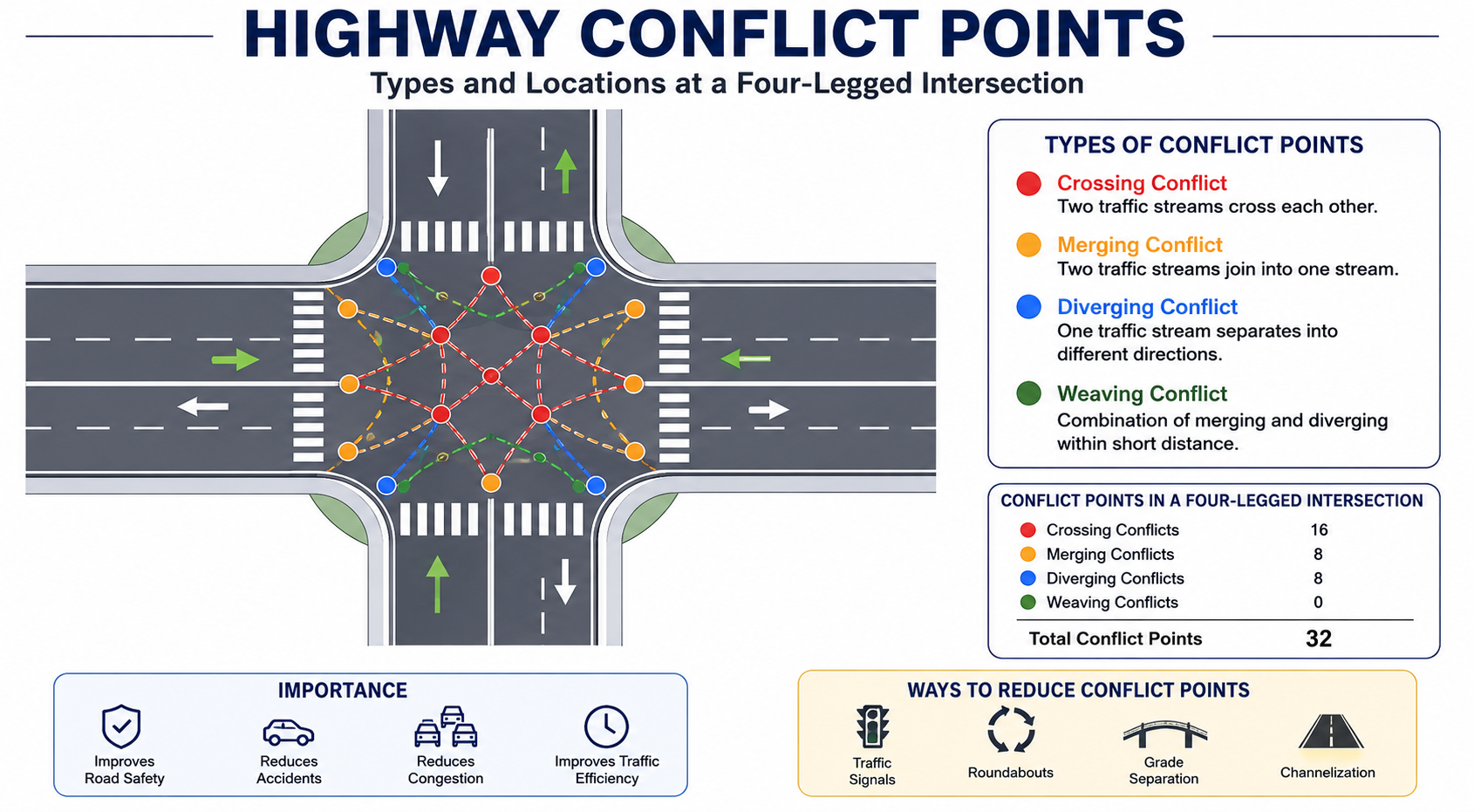
A conflict point is any location where the path of one vehicle intersects, merges, diverges, or weaves with the path of another vehicle, creating a possibility of collision. The more conflict points an intersection has, the higher the operational complexity and crash risk.
Types of Highway Conflict Points
Conflict Points at Different Intersections
Four-Legged Intersection
A traditional four-arm intersection has the highest number of conflict points. According to IRC and traffic engineering references, it contains:
- 16 crossing conflicts
- 8 merging conflicts
- 8 diverging conflicts
Total = 32 conflict points
T-Intersection (Three-Leg Intersection)
Fewer movements than a cross intersection. Typically contains 9 conflict points, making it significantly safer than four-leg intersections.
Roundabout
Roundabouts reduce crossing movements significantly. A typical roundabout has only 8 conflict points, mostly merging and diverging, with very few severe crossing conflicts. This is why roundabouts consistently reduce fatal crashes.
Why Conflict Points Matter
Road Safety
More conflict points increase driver confusion, collision probability, and crash severity. Crossing conflicts are especially dangerous.
Traffic Congestion
Conflict points cause vehicle delay, queue formation, and reduced intersection capacity, directly impacting travel time.
Highway Capacity Reduction
Frequent interruptions reduce Level of Service (LOS), traffic efficiency, and average travel speed.
Human Error
Drivers must judge gap acceptance, speed, turning angle, and signal timing. Poor judgment leads to accidents.
Methods to Reduce Conflict Points
A. Channelization
Using traffic islands, medians, and separate turning lanes organizes traffic, reduces crossing interactions, and improves guidance. IRC recommends channelization for complex intersections.
B. Traffic Signals
Signal phasing separates conflicting traffic streams in time. Two-phase signals can reduce effective conflicts from 32 to 16.
C. Roundabouts
Roundabouts achieve lower speeds, fewer severe conflicts, and continuous movement. Widely used in modern urban traffic systems.
D. Grade Separation
Flyovers and interchanges eliminate crossing conflicts. Examples include cloverleaf, diamond, and trumpet interchanges. These are used on expressways and high-speed corridors.
E. Staggered Intersections
A four-leg intersection is converted into two T-junctions, reducing simultaneous crossing movements.
F. Continuous Flow Intersections (CFI)
Advanced design that relocates turning movements away from the main junction, resulting in fewer signal phases, better throughput, and reduced crossing conflicts.
Conflict analysis is now widely used instead of waiting for actual crashes to occur. Modern traffic engineers use microsimulation models like VISSIM, SIDRA, and FHWA SSAM to analyze potential conflicts before they happen.
Conflict Point Analysis in Highway Engineering
Traffic engineers use traffic volume studies, turning movement counts, crash analysis, microsimulation models, and conflict severity measurements to understand intersection safety.
Role of IRC and International Standards
Indian Standards: IRC SP-41 (Guidelines for Design of At-Grade Intersections), IRC 65, IRC 86.
International References: AASHTO Green Book, FHWA Intersection Design Guide, Highway Capacity Manual (HCM).
These standards define turning radii, sight distance, signal timing, channelization, and conflict reduction techniques.
Modern Research Trends
- AI-Based Traffic Conflict Detection: Using CCTV, computer vision, and deep learning.
- Connected and Autonomous Vehicles: Vehicles communicate to avoid conflicts dynamically.
- Smart Intersections: Adaptive signal systems optimize flow in real time.
Real-World Applications
- Urban junction redesign
- Smart city traffic systems
- Expressway interchange planning
- Accident black spot analysis
- Road safety audits
- Intelligent transportation systems (ITS)
Conclusion
Conflict points are fundamental to highway and traffic engineering because they directly determine intersection safety, traffic efficiency, driver workload, and crash probability. Modern highway engineering aims to minimize conflict points through better geometry, signal control, roundabouts, grade separation, and smart traffic systems. The future of conflict management lies in AI-assisted traffic monitoring and connected autonomous transportation systems.